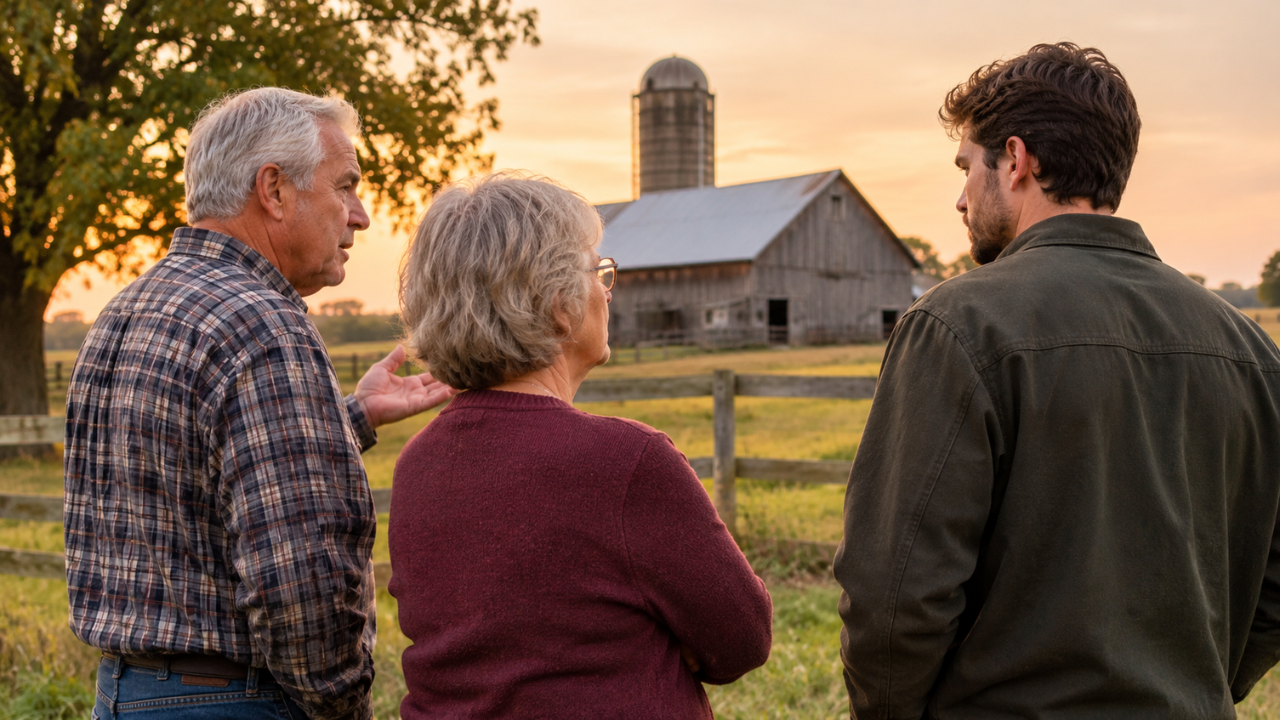
Adding your adult child to a property title feels like a simple way to keep family land in the family. Usually, it backfires.
On November 12, 2026, the Manitoba Court of Appeal handed down a unanimous ruling in a dispute involving Arthur and Mary Ann Berry and their son, Paul Sean Berry, over three adjoining quarter sections of farmland near Fisher Branch, Manitoba. Back in October 2008, the parents signed a lawyer-prepared deed of gift made out of "natural love and affection" and transferred the land title into joint tenancy with Paul in November 2008. Fifteen years later, after a bitter family rift in 2023 and a notice severing the joint tenancy in October 2024, the appeals court ruled that Paul had received an immediate one-third ownership interest back in 2008. It overturned the lower court's refusal and ordered the farm sold under Manitoba's Law of Property Act.
That's the trap with casual title transfers. Parents think they're just setting up a smooth succession plan or protecting themselves down the road. Courts look at the legal words on paper.
Why joint ownership on a family farm turns ugly
Parents add kids to titles for all sorts of understandable reasons. Maybe they want probate avoided. Maybe they assume the kid will farm the land and keep it intact. In the Berry case, the parents said they expected to keep operating the farm until they no longer could and to live in their farmhouse for life, with no separate written agreement spelling out those terms.
Once you put someone on title as a joint tenant, you've handed them real legal leverage while you're still alive. Joint tenancy gives co-owners an undivided interest in the whole property and a right of survivorship. Even better—or worse, depending on whose side you're on—any joint tenant can unilaterally sever the joint tenancy without the others' consent.
When Arthur and Mary Ann served notice to sever the joint tenancy in October 2024, the title shifted so each parent and Paul held an undivided one-third interest as tenants in common. Once you're tenants in common, there's no automatic right of survivorship, and a co-owner with an undivided share can seek a court-ordered sale or partition under legislation like Manitoba's Law of Property Act if relations collapse.
Honestly, people treat land titles like a handshake deal. They aren't. A deed of gift is a formal legal instrument, and judges give heavy weight to what the document actually says over informal family assumptions made years earlier.
Legal ownership versus what parents actually intended
In March 2025, the Manitoba Court of King's Bench had sided with the parents, concluding they intended to give Paul only a right of survivorship that would take effect after their deaths rather than an immediate interest he could exercise during their lifetimes. That lower court judge also leaned on the "clean hands" doctrine to refuse a sale amid competing allegations over farm operations, wages, and machinery.
The Court of Appeal saw it differently. It held that the 2008 deed of gift showed an intent to grant an immediate ownership interest, and that wanting to keep living on and farming the land didn't conflict with shared ownership. It also rejected applying the clean-hands doctrine to block the sale over separate, unresolved disputes about how the farm business or equipment was handled.
In Canadian estate and property law, disputes over gratuitous transfers to adult children often implicate principles shaped by the Supreme Court of Canada's landmark decision in Pecore v. Pecore (2007 SCC 17), which addressed presumptions of resulting trust versus gift when parents transfer assets without receiving payment in return. While Pecore dealt with joint investment accounts rather than Manitoba farmland, the broader lesson across Canadian courts is consistent: unclear or unwritten expectations invite expensive litigation when family harmony breaks down.
A few things make farm disputes especially brutal:
- Mixed personal and business lives: When a family member both lives on the property and works the land—with disputed accounts over wages, management roles, or equipment—personal hurt blends straight into property rights.
- Changing family plans: Bringing up plans to add other siblings to the title (in this case, daughters Jeanette and Lynette) can trigger instant resentment if one child believes they've already been promised or earned a specific stake.
- Forced liquidation: Once a court orders a sale because co-owners can't co-exist on title, sentimental value doesn't stop the market. The family farm gets sold.
What smart families do instead of casual title transfers
If you own farmland, a cabin, or a family home, putting a child's name on title just to "keep things simple" is a gamble. You're trading control today for hope that nobody changes their mind in ten or twenty years.
Better approaches usually start with separating who owns what from who runs the operation and who lives where. Depending on your province or jurisdiction and your tax picture, families often look at formal succession agreements, partnership or corporate structures for active farming operations, explicit life-interest or occupancy terms drafted cleanly by counsel, or estate planning through a will rather than an unguarded lifetime gift on title. Tax rules on lifetime transfers and deemed dispositions can also hit hard if you transfer real estate without getting tailored tax advice first.
If you're thinking about adding a family member to a property title—or if you're already on title with relatives and feel the ground shifting—take these concrete steps now:
- Pull the exact title and transfer documents. Don't rely on memory from years ago. Check whether the property is held as joint tenants or tenants in common and read the exact wording of any transfer or deed of gift.
- Put operational expectations in writing. If someone is farming the land, paying rent, receiving wages, or living in a home on the property, document those terms separately from land ownership so business disagreements don't blow up the title.
- Talk to a local real estate and estate lawyer before signing anything. Ask directly how a transfer affects your control during your lifetime, what happens if relationships sour, and what tax consequences apply where the land sits.
Land is concrete, permanent, and unforgiving when family trust runs out. Get the legal structure right before the fight starts.